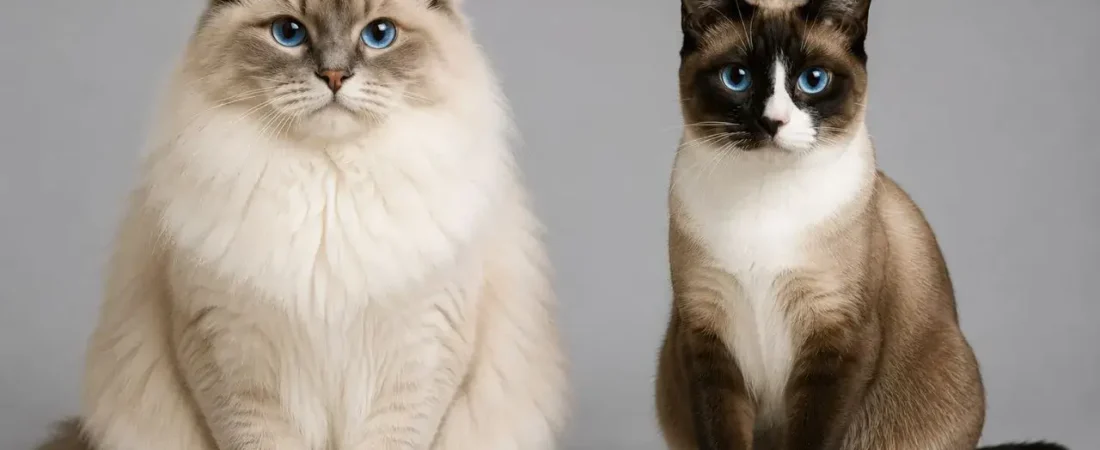
Ragdoll vs Siamese is a choice between two affectionate, people-focused cat breeds with different everyday needs. Ragdolls are larger, semi-longhaired and often calmer, while Siamese cats are sleek, highly active and famously vocal. Neither breed is automatically better: the right fit depends on how much interaction, play, grooming and company you can provide.
If you are weighing up a Ragdoll vs Siamese, this guide compares appearance, personality, activity, grooming, health considerations, costs and suitability for different homes. Breed tendencies are useful starting points, but every cat has an individual temperament. A careful Ragdoll vs Siamese comparison should focus on daily care and compatibility, not just which cat looks more appealing.
Reviewed and updated on October 25, 2026.
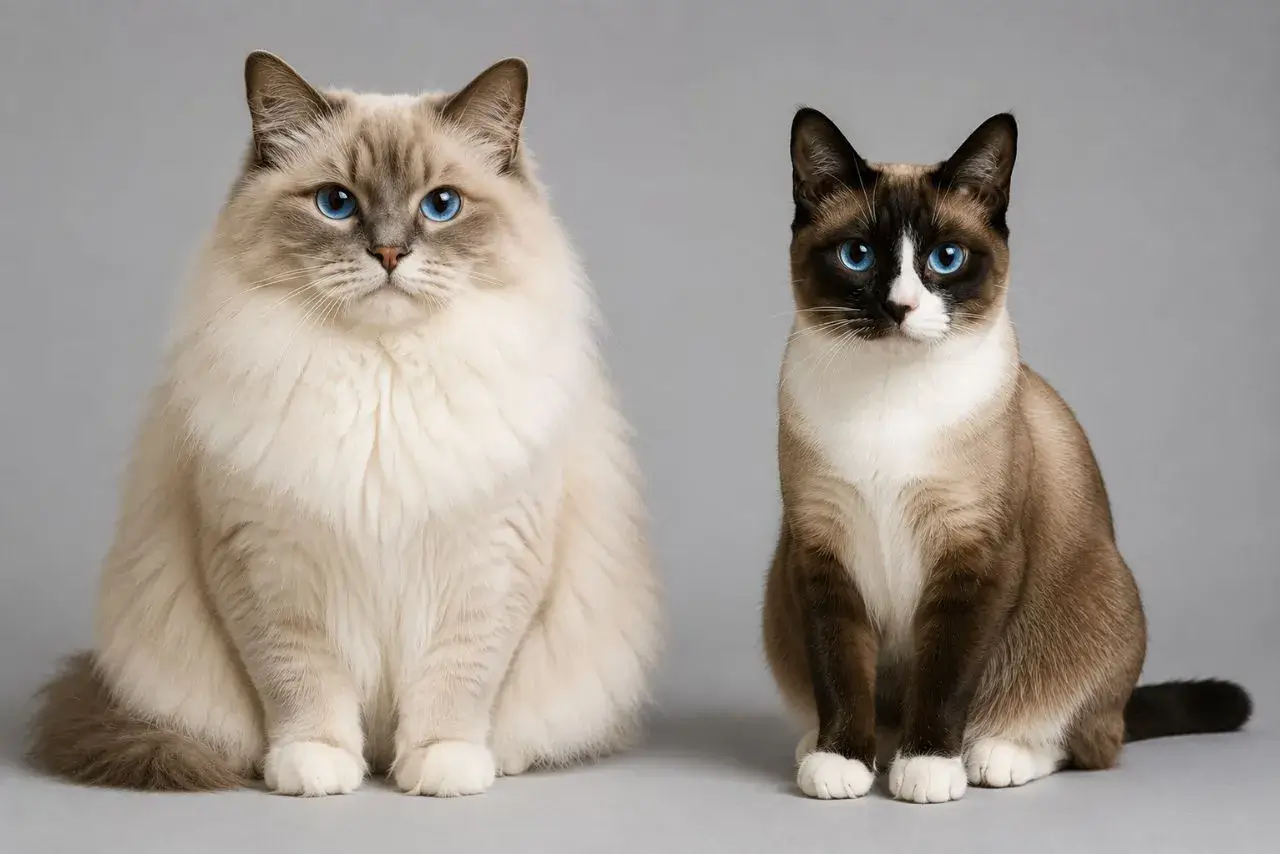
Visual Differences
| Feature | Ragdoll | Siamese |
|---|---|---|
| Build and size | Large, sturdy; adult females commonly 10–15 lb and males 15–20 lb | Medium, slender and athletic; adult females commonly 5–8 lb and males 8–12 lb |
| Coat | Semi-long, silky coat | Short, fine coat close to the body |
| Eyes and pattern | Traditional pointed Ragdolls have blue eyes and darker points | Blue eyes and darker points on face, ears, legs and tail |
| Typical energy | Often relaxed, but still needs daily play | Usually active, agile and play-driven |
| Vocal style | Often quieter, though individuals vary | Often very vocal and communicative |
| Grooming | Comb several times a week as needed to prevent tangles | Usually a weekly brush is enough |
| Alone-time needs | Social and benefits from company and enrichment | Very social and often struggles with long periods alone |
| Cost | Varies by country, pedigree and breeder | Varies by country, pedigree and breeder |
| Lifespan | Often reaches the mid-to-late teens, but individual outcomes vary | Can also live into the teens or longer with good care |
Ragdoll vs Siamese Cat History
Ragdoll Cat
The Ragdoll was developed in California in the 1960s by breeder Ann Baker, with Josephine often identified as a foundation cat. Modern breed descriptions emphasize a large, balanced body, semi-long silky coat, blue eyes and a pointed pattern. Read the TICA Ragdoll Breed Profile for recognized characteristics and care guidance.
Siamese cats have a much older history, with depictions of pointed cats appearing in manuscripts from what is now Thailand. They became known in Europe and North America during the late 19th century. Today, the Siamese is recognized for its slender, muscular shape, short coat, blue eyes, intelligence and social, vocal nature. See the TICA Siamese Breed Profile for the breed overview.
Physical Appearance
Ragdolls are generally larger than Siamese cats. Males weigh between 15 to 20 pounds, and females weigh between 10 to 15 pounds. They have semi-long fur, which is soft and silky to the touch. Their colorpoint pattern is similar to Siamese cats, but Ragdolls are more colorful than Siamese, and they come in a broad range of colors, including seal, blue, chocolate, lilac, flame, cream, and more. They often have vivid blue eyes. They also have a different color distribution over their bodies, with darker colors on their ears, face, tail, and paws, which contrasts with their lighter body.
Siamese cats are medium-sized, with males generally weighing between 9 to14 pounds and females weighing between 6 to 10 pounds. Their fur is short, smooth, and sheds very little. They have unique color markings on their faces, ears, paws, and tails. Like Ragdolls, Siamese cats come in a variety of colors, including seal, chocolate, blue, and lilac. They also have blue eyes.
Personality & Temperament
Ragdolls are often described as affectionate, people-oriented and comparatively quiet. Some relax when held, but not every Ragdoll enjoys being carried or goes limp, so always support the cat properly and let it choose contact. They enjoy company and play, and kittens or young adults may be much more energetic than the relaxed adult stereotype suggests.
Ragdolls are not truly independent by default. Many seek their people out and prefer being near family members, even when they are not demanding constant conversation. A quiet personality does not mean a cat can be left alone for long stretches without enrichment or social contact.
Siamese cats are often more active and vocal than Ragdolls. They commonly seek conversation, climbing opportunities and interactive games. Because they are highly social, they may become distressed or bored if left alone for long periods. A predictable play routine, puzzle feeders and safe vertical spaces help meet their needs.
Siamese cats are intelligent and playful, often enjoying games that challenge their minds, such as brain-teasers or fetch. They form strong bonds with their owners and can be quite loyal, usually following their humans from room to room.
Grooming
Ragdolls have a semi-long, silky coat that needs regular combing. Start with a few sessions a week and adjust to the individual coat, season and any tangles. Check behind the ears, under the front legs, around the collar and along the hindquarters. Gentle, consistent grooming helps you notice skin changes and prevents small knots from turning into painful mats.
Siamese cats have a short, fine coat that usually needs less work. A weekly brush or grooming glove can remove loose hair and is also a useful chance to check the skin. Both breeds still need nail care, dental care, parasite prevention and routine veterinary checkups. Short fur does not mean a cat has no grooming needs.
Health
Ragdolls can be affected by hypertrophic cardiomyopathy (HCM), a disease in which the heart muscle thickens. Ask a breeder about the parents’ health history and relevant screening, and discuss any family history with your veterinarian. Genetic testing can identify specific known variants but cannot rule out every cause of heart disease. Avoid presenting PKD, bladder stones or feline infectious peritonitis as inevitable breed outcomes: individual risk depends on multiple factors, and diagnosis requires veterinary assessment.
Life expectancy varies with genetics, preventive care, diet, weight, environment and chance. TICA notes that many Ragdolls reach their mid-to-late teens, but no lifespan is guaranteed. Keep routine veterinary appointments and seek prompt advice if you notice changes in appetite, breathing, activity, urination or behavior.
Siamese cats can also develop health problems, including some inherited conditions reported in the breed, such as certain forms of amyloidosis and progressive retinal atrophy. Do not assume a cat has a condition because it is Siamese; ask about family history and screening where available. A veterinarian can advise which examinations or tests are appropriate for the cat’s age and background.
Siamese cats may also live well into their teens, and some live longer. Breed averages are only estimates, not promises. Maintaining a healthy weight, dental hygiene, enrichment and preventive veterinary care supports wellbeing in either breed.
Cost and Availability
Ragdoll kitten prices vary widely by country, breeder, pedigree, registration and what veterinary care is included. The figures advertised online may not reflect current prices in your area, so request an itemized quote rather than treating a single dollar range as universal. Budget for food, litter, grooming tools, vaccinations, routine checkups, insurance if chosen and emergency care.
Siamese kittens can also vary considerably in price. Compare what is included in the purchase or adoption fee, the breeder’s health practices, registration documents, vaccination records and return policy. Adoption may be an option for either breed or breed mix. Avoid choosing solely on the lowest upfront price, because lifetime care costs matter more.
Family Suitability
Ragdoll: Ragdolls can suit families who want an affectionate companion and can keep up with coat care, play and routine health needs. Introduce children and other pets gradually, supervise interactions, and teach children to let the cat leave whenever it wants. Calm tendencies should never be mistaken for permission to carry or restrain a cat.
Many Ragdolls can live successfully with children and other pets, including cat-friendly dogs, when introductions are managed well. Individual temperament matters more than breed reputation, and every cat needs a quiet, secure retreat.
Siamese: Siamese cats may be a better match for people who enjoy a talkative, clever and active companion. They benefit from daily interactive play, climbing structures, training and regular company. Their vocal nature can be delightful for some households and difficult for people who need a very quiet home.
Neither breed should be expected to cope with long periods of isolation without a plan for social contact and enrichment. If you work long hours, consider your schedule, a trusted pet sitter, interactive feeding and whether a compatible companion would suit the individual cat. Another pet is not a guaranteed solution and introductions still matter.
Daily Life, Exercise and Enrichment
Ragdoll vs Siamese is not only a question of looks. Think about what an ordinary weekday would feel like for the cat. Both breeds need play, affection, scratching options, safe places to rest and predictable routines. The main difference is often the intensity of interaction the individual cat seeks and how much coat care it needs. This Ragdoll vs Siamese comparison is most useful when you match those needs to the time and space you can offer.
Play and Training Needs
Many Siamese cats enjoy energetic chase games, puzzle feeders, clicker training and climbing to high perches. Ragdolls also need interactive play, but some adults are happier with a mix of short play sessions and relaxed time near their people. Rotate toys, use food puzzles safely and avoid relying on laser play alone without a catchable toy at the end. Match the routine to your cat’s age, mobility and interest.
Can They Live in Apartments?
Either breed can live in an apartment if the home is safe and offers enough stimulation. Siamese cats may need more active play and vertical space, while a larger Ragdoll needs sturdy cat furniture and enough room to move comfortably. Secure windows and balconies, provide scratching posts and separate food, water and litter resources where practical. A spacious home does not replace attention, and a small home can work when its environment is thoughtfully arranged.
Which Breed Fits Your Household?
When choosing a Ragdoll vs Siamese, be honest about your schedule and preferences rather than choosing from appearance alone. A Ragdoll may suit someone who wants a large, affectionate cat and is prepared to comb a semi-long coat. A Siamese may suit someone who enjoys frequent vocal interaction, active play and a sleek coat that is easier to maintain. Either breed can be affectionate, independent at times, shy or energetic depending on the individual.
- Choose a Ragdoll if: you prefer a larger cat, can keep up with regular combing, and appreciate a generally calm companion that still needs daily play and company.
- Consider a Siamese if: you enjoy a vocal, agile cat, have time for interactive play and training, and want a short coat that is usually simple to groom.
- Pause and assess if: the cat will be alone for most of the day, you cannot budget for veterinary care, or your household expects a cat to tolerate being carried or handled against its wishes.
For a broader look at the Ragdoll’s coat and patterns, see our Ragdoll Cat Colors and Patterns Guide. For another breed comparison, read Balinese vs Ragdoll Cat. These related guides can help you compare breed traits, but the personality of the cat in front of you matters too.
How to Choose a Responsible Breeder or Rescue
Ask to see the kitten or cat’s veterinary records, vaccination and parasite-control history, and any available pedigree or registration documents. A responsible breeder should welcome questions about parent health, socialization, living conditions and what happens if you can no longer care for the cat. For Ragdolls, ask about HCM in the family and the scope of any screening. For Siamese cats, ask about known inherited conditions in the line. A test result should be explained accurately and should not be presented as a guarantee of lifelong health.
If adopting, ask the rescue or shelter what is known about the cat’s behavior, health, response to children and other animals, and tolerance for being alone. Spend time observing the cat when possible. Do not assume that a breed label predicts every behavior, and do not choose a kitten solely because it appears quiet during a short visit.
Ragdoll Cat vs Siamese: Which Is Easier to Care For?
Ragdoll Cat vs Siamese comparisons often come down to coat care versus activity and attention. Siamese grooming is usually easier because the coat is short, but their need for interaction and stimulation can be demanding. Ragdolls require more regular combing and careful attention to tangles, and they still need play, social contact and a healthy weight. Neither breed is a low-effort pet.
Siamese Cat vs Ragdoll for First-Time Owners
Siamese Cat vs Ragdoll is not a simple beginner-versus-expert decision. First-time owners should consider the time available for interaction, noise sensitivity, grooming routine, household members and access to veterinary care. A well-socialized adult cat with a known temperament may be a better fit than a kitten of either breed. Ask the breeder, rescue or veterinarian for help matching the individual cat to your circumstances.
FAQs (Because People Keep Asking)
Which Cat Needs More Grooming?
Ragdolls usually need more grooming because their semi-long coat can tangle, while Siamese cats have a short coat that is easier to maintain. Individual coats and shedding patterns vary, so establish a routine that keeps the skin and fur comfortable.
Can Ragdolls and Siamese Cats Be Left Alone?
Both breeds need social contact and enrichment. Siamese cats are often particularly people-oriented and may find long periods alone difficult. Plan for play, safe activities and help from a trusted person if you are away for extended periods.
Are Ragdolls Quieter Than Siamese Cats?
Ragdolls are often quieter, while Siamese cats are known for frequent, expressive vocalization. There are exceptions, and a cat’s individual personality, environment and health can influence how much it vocalizes.
Which Breed Lives Longer?
There is no reliable way to predict an individual cat’s lifespan from breed alone. Both breeds can live into their teens or longer. Genetics, preventive veterinary care, weight management, dental health and safe living conditions all influence wellbeing.
Final Verdict: Ragdoll vs Siamese
The best choice depends on the companionship you want and the care you can reliably provide. Ragdolls are larger and need more coat maintenance, while Siamese cats are often more vocal and active. Both need daily play, social contact, preventive veterinary care and a safe home. In the end, Ragdoll vs Siamese comes down to which individual cat fits your household and routine. Meet the cat, ask about its health and behavior, and choose a match for your real life rather than an idealized breed stereotype.
Editorial Note
This comparison summarizes common breed tendencies, not guarantees about individual cats. Size and lifespan ranges are approximate and can vary by registry, sex, genetics and care. This article is educational and does not replace veterinary advice or a professional assessment of a particular cat.
Trusted Sources
- The International Cat Association: Ragdoll Breed Profile, for breed characteristics, coat care, activity and health background.
- The International Cat Association: Siamese Breed Profile, for temperament, body type, activity, grooming and health background.
- Cornell Feline Health Center: Hypertrophic Cardiomyopathy, for general information about feline HCM.
- UC Davis Veterinary Genetics Laboratory: Ragdoll HCM Test, for the scope of the known Ragdoll HCM genetic test.
How This Guide Is Researched and Kept Current
This guide was reviewed and updated on October 25, 2026. Breed descriptions and care recommendations were checked against TICA’s current Ragdoll and Siamese profiles, with veterinary sources used for general health context. Prices and individual health outcomes vary by region and cat, so readers should confirm current details with a reputable breeder, rescue and qualified veterinarian before making a decision.
About the Author
Abdul Khader is a Ragdoll enthusiast, researcher and writer who covers Ragdoll colors, patterns, behavior and everyday care. His work focuses on explaining breed information in practical language and helping readers ask better questions when choosing a cat. He is not a veterinarian, and medical decisions should be discussed with a qualified veterinary professional.
Sources and Further Reading
The following registry and veterinary resources support the breed, care and health information discussed in this guide. Check the original source for current guidance, and consult a veterinarian about the needs of an individual cat.
- The International Cat Association (TICA): Ragdoll Breed Profile
- The International Cat Association (TICA): Siamese Breed Profile
- Cornell Feline Health Center: Hypertrophic Cardiomyopathy
- UC Davis Veterinary Genetics Laboratory: Ragdoll HCM Test
What We Have Covered
This guide compares Ragdoll and Siamese cats and covers:
- Breed history, appearance and the differences between their physical features.
- Personality, temperament, vocalisation, family suitability and daily companionship needs.
- Grooming, health considerations, activity, training and enrichment.
- Living arrangements, first-time ownership and choosing a responsible breeder or rescue.
Choose based on the individual cat’s needs, verified health information and the time and care your household can provide.